Applications

When adaptation replaces the nature of the system, evolution comes to a halt.
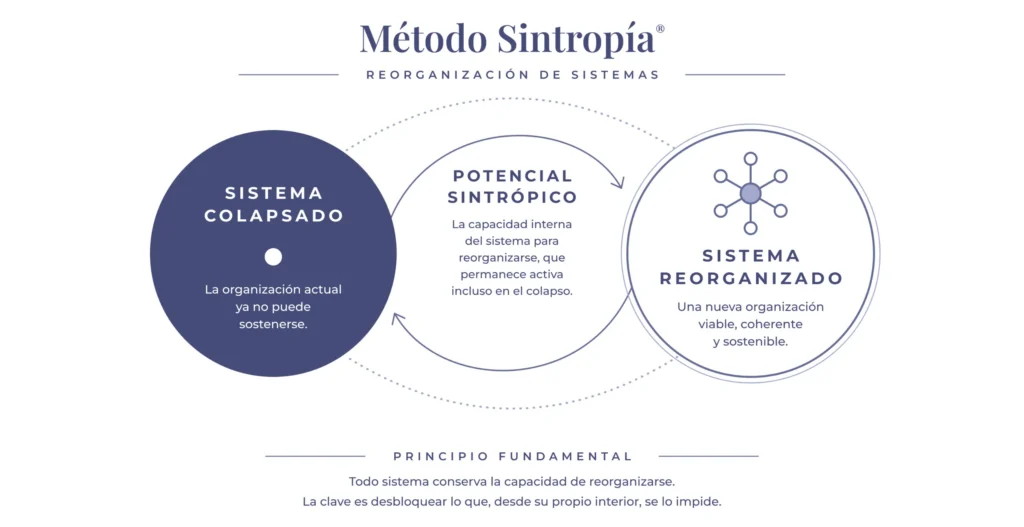
Una célula, un organismo, un equipo, una empresa o un ecosistema son sistemas complejos. Cambian la escala, el lenguaje y la forma, pero todos responden a los mismos principios: se organizan, desarrollan dinámicas para responder a su entorno y conservan una capacidad interna de reorganizarse y evolucionar.
Por eso una organización funciona como un organismo vivo. Cuando sus dinámicas responden a la realidad que tiene delante, el sistema se adapta, se renueva y crece.
El problema aparece cuando esas dinámicas dejan de responder a la realidad. El sistema queda atrapado en estados de bloqueo, repetición o inercia que limitan cada vez más su capacidad de reorganizarse. Entonces aparecen la saturación, la pérdida de eficiencia y respuestas que terminan condicionando su desarrollo.
Organizations and Companies
Teams and Leadership
A Different Way to Understand What Is Happening
The Syntropy® Method makes it possible to address situations in which conventional solutions fail to significantly change how an organization operates.
We analyze the system as a whole—its structure, relationships, functions, patterns, and dynamics—to identify what is influencing how it operates and what needs to be reorganized.
The result is not a new solution to add to the existing ones, but rather a different understanding of the system that allows us to make decisions with a broader perspective and direct change toward what truly needs to be transformed.
PAS
The Systemic Analysis Program (PAS) is a proprietary tool developed by Syntropy Biophysics® to apply the Syntropy® Method to the analysis of complex systems.
The PAS makes it possible to integrate and correlate different sources of information to construct a structural understanding of the system, identify patterns and dynamics, and understand the conditions that may be influencing its functioning and evolution.
Its development makes it possible to apply the Syntropy® Method analysis as a systematic process, expanding the ability to observe and compare the information that emerges from each system.

What does the PAS allow you to see?
The PAS makes it possible to visualize the structure of a system in order to understand what determines its current functioning, what dynamics may be influencing its evolution, and what conditions may facilitate or hinder change.
Understanding
: The state of the system, its tensions, inertia, and patterns.
: Anticipating Possible Trajectories, Scenarios, and Conditions for Change.
Compare
How the system evolves and how it responds to new situations or interventions.
It's not just a matter of knowing what's happening, but of understanding how the system is responding and what dynamics may be driving that response.

Research and Development
Each system analyzed expands our understanding of the organization and evolution of complex systems, allowing us to test hypotheses, identify new patterns, develop tools, and continue to put the Syntropy® Method to the test in different contexts.
At Syntropy Biophysics®, we view research as an ongoing process. Each new application allows us to learn about the behavior of systems, incorporate new knowledge, and progressively expand the method’s range of applications.

The systemic nature
The Syntropy® Method is based on a different way of looking at complex systems: understanding not only what a system manifests, but also the dynamics that organize its functioning and determine its ability to adapt and evolve.
Its application makes it possible to identify patterns, inertia, tensions, and configurations that may be limiting a system's ability to reorganize itself and generate new forms of response.
For this reason, the Syntropy® Method is not limited to a specific discipline. Its observational framework can be applied to different types of complex systems, adapting in each case to their nature and context.
Diágnostico Sistémico y Estrategia
Comprender qué está ocurriendo antes de tomar decisiones relevantes
Cuando una organización se bloquea, lo habitual es actuar sobre los síntomas. Pero si no se comprende qué dinámica sostiene el problema, este vuelve a aparecer. Nuestro diagnóstico, basado en el PAS, permite ver cómo funciona realmente el sistema y qué necesita para reorganizarse.
Lectura Sistémica · Informe Estratégico de Reorganización · Análisis para decisiones clave

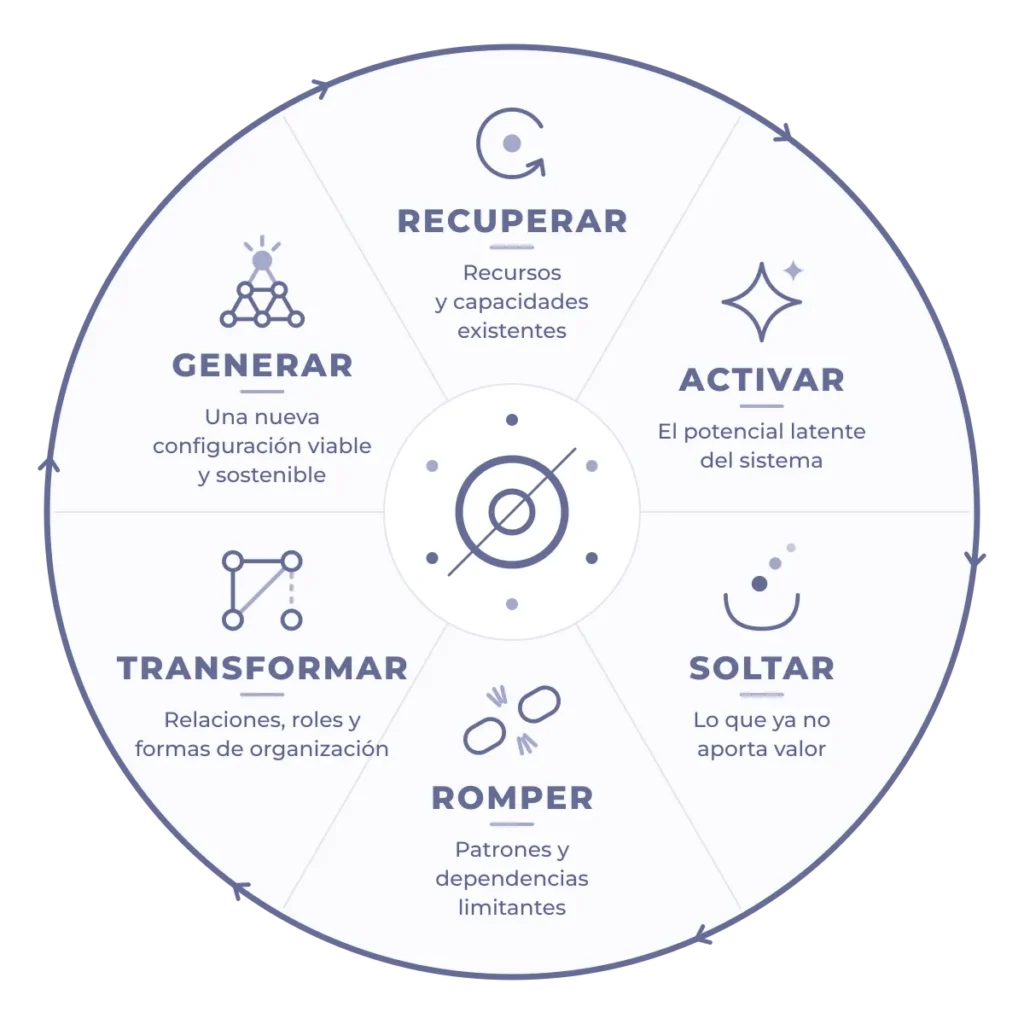
The 6 Steps of the Syntropy Method
Más allá del análisis racional
Entramos en la organización y trabajamos directamente con sus equipos. Combinamos técnicas de facilitación de distintas disciplinas para trabajar no solo con lo que las personas piensan o dicen, sino también con lo implícito: lo que se percibe pero no se verbaliza, y que condiciona cómo se relacionan y deciden.
No buscamos solo generar conciencia. Buscamos activar lo que está dormido.
El resultado es una transformación real: relaciones más sanas y equilibradas, y una organización que activa el potencial de sus personas y lo convierte en su principal valor.
Cuatro días para despertar lo que hay en ti
No es un retiro para desconectar. Es una experiencia intensa para encontrarte con tus patrones, recuperar lo que habías olvidado y descubrir lo que eres capaz de generar.
Recorrerás en primera persona los seis pasos del Método Sintropía® y aprenderás a aplicarlos en tu vida y en tu práctica profesional.
Lo que está dormido no despierta desde la comodidad.
Para coaches, consultores/as, facilitadores/as, profesionales de RR. HH. y personas que lideran equipos.
Why Sintropía?

Syntropy does not study change. It studies the conditions that make it possible.
The word “Syntropy” was not chosen merely to name a method. It represents our understanding of the evolution and reorganization of complex systems and encapsulates the principle that guides our work.
For years, analytical models have focused on understanding symptoms and addressing what a system exhibits. This approach allows us to tackle numerous problems, but it does not always explain why some systems continue to reproduce certain dynamics even after processes, structures, resources, or even the people within them have changed.
This observation led us to ask a different question:
What happens when the problem lies not only in what the system manifests, but also in the way it responds to reality?
The Syntropy® Method stems from this question and proposes observing which configurations and dynamics influence a system’s response and which conditions might enable it to reorganize itself and develop new ways of functioning.
To study a system is to understand how it is organized. To understand how it is organized is to discover how it can evolve.
About Us
Syntropy Biophysics® began as a research project dedicated to the study of complex systems and the dynamics that determine their ability to reorganize and evolve.
For more than eleven years, this observational work has allowed us to identify recurring patterns in systems of various kinds, which led to the development of the Syntropy® Method.
Based on this experience, we have developed our own framework for observation and analysis, which we currently apply to the fields of organizations, companies, teams, and leadership, while we continue to investigate its potential applications in other complex systems.
Our work combines research, methodological development, and practical application with one goal in mind: to understand what causes certain patterns to continue repeating themselves and what conditions may promote the reorganization of a system.